Fractions

In Mathematics, fractions are defined as the parts of a whole. The whole can be an object or a group of objects. In real life, when we cut a piece of cake from the whole of it, then the portion is the fraction of the cake. A fraction is a word that is originated from Latin. In Latin, “Fractus” means “broken”. In ancient times, the fraction was represented using words. Later, it was introduced in numerical form.
The fraction is also termed as a portion or section of any quantity. It is denoted by using ‘/’ symbol, such as a/b. For example, in 2/4 is a fraction where the upper part denotes the numerator and the lower part is the denominator. In this article, we are going to learn the definition of fractions in Maths, types of fractions, conversion from fractions to decimals, and many solved examples with complete explanation.
What are Fractions?
Definition 1: A fraction represents a numerical value, which defines the parts of a whole.
Definition 2: A fraction is a number that represents a part of a whole.
Generally, the fraction can be a portion of any quantity out of the whole thing and the whole can be any specific things or value.
The basics of fractions explain the top and bottom numbers of a fraction. The top number represents the number of selected or shaded parts of a whole whereas the bottom number represents the total number of parts.
Suppose a number has to be divided into four parts, then it is represented as x/4. So the fraction here, x/4, defines 1/4th of the number x. Hence, 1/4 is the fraction here. It means one in four equal parts. It can be read as one-fourth or 1/4. This is known as fraction.

Fractions play an important part in our daily lives. There are many examples of fractions you will come across in real life. We have to willingly or unwillingly share that yummy pizza amongst our friends and families. Three people, four slices. If you learn and visualize fractions in an easy way, it will be more fun and exciting. For example, slice an apple into two parts, then each part of the sliced apple will represent a fraction (equal to 1/2).
Parts of Fractions
The fractions include two parts, numerator and denominator.
- Numerator: It is the upper part of the fraction, that represents the sections of the fraction
- Denominator: It is the lower or bottom part that represents the total parts in which the fraction is divided.
Example: If 3/4 is a fraction, then 3 is the numerator and 4 is the denominator.

Properties of Fractions
Similar to real numbers and whole numbers, a fractional number also holds some of the important properties. They are:
- Commutative and associative properties hold true for fractional addition and multiplication
- The identity element of fractional addition is 0, and fractional multiplication is 1
- The multiplicative inverse of a/b is b/a, where a and b should be non zero elements
- Fractional numbers obey the distributive property of multiplication over addition
Types of Fractions
The primary parts of a fraction are the numerator and the denominator. Based on these, different types of fractions can be defined. Let us look at some common types of fractions.

Mixed Fractions to Improper Fractions
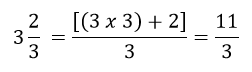
Mixed fractions can be converted to improper fractions by multiplying the whole number by the denominator and adding it to the numerator. It becomes the new numerator, and the denominator remains unchanged.
Based on the properties of numerator and denominator, fractions are sub-divided into different types. They are:
- Proper fractions
- Improper fractions
- Mixed fractions
- Like fractions
- Unlike fractions
- Equivalent fractions
Proper Fractions
The proper fractions are those where the numerator is less than the denominator. For example, 8/9 will be a proper fraction since “numerator < denominator”.
Improper Fractions
The improper fraction is a fraction where the numerator happens to be greater than the denominator. For example, 9/8 will be an improper fraction since “numerator > denominator”.
Mixed Fractions
A mixed fraction is a combination of the integer part and a proper fraction. These are also called mixed numbers or mixed numerals. For example:
Like Fractions
Like fractions are those fractions, as the name suggests, that are alike or same.
For example, take ½ and 2/4; they are alike since if you simplify it mathematically, you will get the same fraction.
Unlike Fractions
Unlike fractions, are those that are dissimilar.
For example, ½ and 1/3 are unlike fractions.
Equivalent Fractions
Two fractions are equivalent to each other if after simplification either of two fractions is equal to the other one.
For example, ⅔ and 4/6 are equivalent fractions.
Since, 4/6 = (2×2)/(2×3) = 2/3
Unit Fractions
A fraction is known as a unit fraction when the numerator is equal to 1.
- One half of whole = ½
- One-third of whole = 1/3
- One-fourth of whole = ¼
- One-fifth of whole = ⅕

Fraction on a Number Line
We have already learned to represent the integers, such as 0, 1, 2, -1, -2, on a number line. In the same way, we can represent fractions on a number line.
For example, if we have to represent 1/5 and 3/5 parts of a whole, then it can be represented as shown in the below figure.

Since the denominator is equal to 5, thus 1 is divided into 5 equal parts, on the number line. Now the first section is 1/5 and the third section is 3/5.
Similarly, you can practice marking more of the fractions on the number line, such as 1/2, 1/4, 2/11, 3/7, etc.

Rules for Simplification of Fractions
There are some rules we should know before solving the problems based on fractions.
Rule #1: Before adding or subtracting fractions, we should make sure that the denominators are equal. Hence, the addition and subtraction of fractions are possible with a common denominator.
Rule #2: When we multiply two fractions, then the numerators are multiplied as well as the denominators are multiplied. Later simplify the fraction.
Rule #3: When we divide a fraction from another fraction, we have to find the reciprocal of another fraction and then multiply with the first one to get the answer.
Adding Fractions
The addition of fractions is easy when they have a common denominator.
For example, ⅔ + 8/3 = (2+8)/3 = 10/3
Hence, we need to just add the numerators here.
Adding Fractions with Different Denominators
If the denominators of the two fractions are different, we have to simplify them by finding the LCM of denominators and then making it common for both fractions.
Example: ⅔ + ¾
The two denominators are 3 and 4
Hence, LCM of 3 and 4 = 12
Therefore, multiplying ⅔ by 4/4 and ¾ by 3/3, we get;
8/12 + 9/12
= (8+9)/12
Subtracting Fractions
The rule for subtracting two or more fractions is the same as for addition. The denominators should be common to subtract two fractions.
Example: 9/2 – 7/2 = (9-7)/2 = 2/2 = 1
Subtracting with Different Denominators
If the denominators of the two fractions are different, we have to simplify them by finding the LCM of denominators and then making it common for both fractions.
Example: ⅔ – ¾
The two denominators are 3 and 4
Hence, LCM of 3 and 4 = 12
Therefore, multiplying ⅔ by 4/4 and ¾ by 3/3, we get;
8/12 – 9/12
= (8-9)/12
Multiplication of Fractions
As per rule number 2, we have discussed in the previous section, when two fractions are multiplied, then the top part (numerators) and the bottom part (denominators) are multiplied together.
If a/b and c/d are two different fractions, then the multiplication of a/b and c/d will be:
(a/b) x (c/d) = (axc)/(bxd) = (ac/bd)
Example: Multiply ⅔ and 3/7.
(⅔) x (3/7) = (2×3)/(3×7) = 2/7
Division of Fractions
If we have to divide any two fractions, then we will use here rule 3 from the above section, where we need to multiply the first fraction to the reciprocal of the second fraction.
If a/b and c/d are two different fractions, then the division a/b by c/d can be expressed as:
(a/b)÷(c/d) = (a/b)x(d/c) = (ad/bc)
Example: Divide ⅔ by 3/7.
(⅔) ÷ (3/7) = (⅔) x (7/3) = (2×7)/(3×3) = 14/9
Real-Life Examples of Fractions
Let us visualize some of the fractions examples:
- Imagine a pie with four slices. Taking two slices of pie for yourself would mean that you have two out of the four. Hence, you represent it as 2/4.
- Fill half a glass of water. What do you see? 1/2 glass is full. Or 1/2 glass is empty. This 1/2 is fractions where 1 is the numerator that is, the number of parts we have. And 2 is the denominator, the number of parts the whole glass is divided into.

How to Convert Fractions To Decimals?
As we already learned enough about fractions, which are part of a whole. The decimals are the numbers expressed in a decimal form which represents fractions, after division.
For example, Fraction 1/2 can be written in decimal form as 0.5.
The best part of decimals are they can be easily used for any arithmetic operations such as addition, subtraction, etc. Whereas it is difficult sometimes to perform operations on fractions. Let us take an example to understand;
Example: Add 1/6 and 1/4.
solution: 1/6 = 0.17 and 1/4 = 0.25
Hence, on adding 0.17 and 0.25, we get;
How to Simplify Fractions?
To simplify the fractions easily, first, write the factors of both numerator and denominator. Then find the largest factor that is common for both numerator and denominator. Then divide both the numerator and the denominator by the greatest common factor (GCF) to get the reduced fraction, which is the simplest form of the given fraction. Now, let us consider an example to find the simplest fraction for the given fraction.
For example, take the fraction, 16/48
So, the factors of 16 are 1, 2, 4, 8, 16.
Similarly, the factors of 48 are 1, 2, 3, 4, 6, 8, 12, 16, 24, 48.
Thus, the greatest common factor for 16 and 48 is 16.
i.e. GCF (16, 48) = 16.
Now, divide both the numerator and denominator of the given fraction by 16, we get
16/48 = (16/16) / (48/16) = 1/3.
Hence, the simplest form of the fraction 16/48 is 1/3.
Solved Examples on Fractions
Example 1:
Is 12/6 a fraction?
Solution:
Yes, it is. It is called an improper fraction.
Example 2:
Convert 130.1200 into a fraction.
Solution:
Here will use the concept of how to convert decimals into fractions
130.1200 = 130.1200/10000
= 13012/100
Example 3:
Add 3/ 5 and 10/15.
Solution:
3 /5 + 10/15
LCM of 5 and 15 is 15
= (9 + 10)/15
= 19/15
Example 4:
Which of the following fraction is the largest?
(a) 29/23
(b) 29/27
(c) 29/25
(d) 29/30
Solution:
To find whether the largest fractions among the given options, first convert the fractional value to the decimal value.
(a) 29/23 = 1.261
(b) 29/27 = 1.074
(c) 29/25 = 1.16
(d) 29/30 = 0.967
Thus, 29/23 is the largest fraction among the given options.
Hence, option (a) 29/23 is the correct answer.
Example 5:
Reduce the fraction 15/65 to the simplest form.
Solution:
Given fraction: 15/65.
Factors of 15: 1, 3, 5 and 15
Factors of 65: 1, 5, 13, and 65
Hence, the greatest common factor of 15 and 65 is 5.
i.e. GCF (15, 65) = 5.
Now, divide both the numerator and the denominator of the given fraction (16/65) by 5, we get
15/65 = (15/5) / (65/5) = 3/13.
Hence, the simplest form of the fraction 15/65 is 3/13.
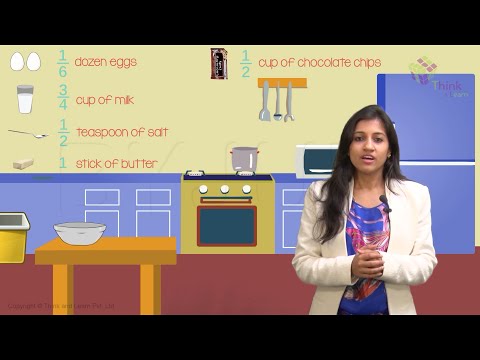
Video Lesson
Understanding Fractions
10,38,881
Practice Questions on Fractions
Solve the following:
- 3/7+9/2-8.
- 22/7+8/11.
- 32/9 x 81/4.
- 44/9 ÷ 36/4.
- Reduce 35/84 to the simplest form.
- Convert the fraction 81/63 to the reduced form.
Simple, common, or vulgar fractions[edit]
A simple fraction (also known as a common fraction or vulgar fraction, where vulgar is Latin for "common") is a rational number written as a/b or , where a and b are both integers.[9] As with other fractions, the denominator (b) cannot be zero. Examples include , , , and . The term was originally used to distinguish this type of fraction from the sexagesimal fraction used in astronomy.[10]


Common fractions can be positive or negative, and they can be proper or improper (see below). Compound fractions, complex fractions, mixed numerals, and decimals (see below) are not common fractions; though, unless irrational, they can be evaluated to a common fraction.
- A unit fraction is a common fraction with a numerator of 1 (e.g., ). Unit fractions can also be expressed using negative exponents, as in 2−1, which represents 1/2, and 2−2, which represents 1/(22) or 1/4.
- A dyadic fraction is a common fraction in which the denominator is a power of two, e.g. .


In Unicode, precomposed fraction characters are in the Number Forms block.
Proper and improper fractions[edit]
Common fractions can be classified as either proper or improper. When the numerator and the denominator are both positive, the fraction is called proper if the numerator is less than the denominator, and improper otherwise.[11][12] The concept of an "improper fraction" is a late development, with the terminology deriving from the fact that "fraction" means "a piece", so a proper fraction must be less than 1.[10] This was explained in the 17th century textbook The Ground of Arts.[13][14]
In general, a common fraction is said to be a proper fraction, if the absolute value of the fraction is strictly less than one—that is, if the fraction is greater than −1 and less than 1.[15][16] It is said to be an improper fraction, or sometimes top-heavy fraction,[17] if the absolute value of the fraction is greater than or equal to 1. Examples of proper fractions are 2/3, −3/4, and 4/9, whereas examples of improper fractions are 9/4, −4/3, and 3/3.
Reciprocals and the "invisible denominator"[edit]
The reciprocal of a fraction is another fraction with the numerator and denominator exchanged. The reciprocal of , for instance, is . The product of a fraction and its reciprocal is 1, hence the reciprocal is the multiplicative inverse of a fraction. The reciprocal of a proper fraction is improper, and the reciprocal of an improper fraction not equal to 1 (that is, numerator and denominator are not equal) is a proper fraction.


When the numerator and denominator of a fraction are equal (for example, ), its value is 1, and the fraction therefore is improper. Its reciprocal is identical and hence also equal to 1 and improper.

Any integer can be written as a fraction with the number one as denominator. For example, 17 can be written as , where 1 is sometimes referred to as the invisible denominator. Therefore, every fraction or integer, except for zero, has a reciprocal. For example. the reciprocal of 17 is

History
The earliest fractions were reciprocals of integers: ancient symbols representing one part of two, one part of three, one part of four, and so on.[29] The Egyptians used Egyptian fractions c. 1000 BC. About 4000 years ago, Egyptians divided with fractions using slightly different methods. They used least common multiples with unit fractions. Their methods gave the same answer as modern methods.[30] The Egyptians also had a different notation for dyadic fractions in the Akhmim Wooden Tablet and several Rhind Mathematical Papyrus problems.[citation needed]
The Greeks used unit fractions and (later) continued fractions. Followers of the Greek philosopher Pythagoras (c. 530 BC) discovered that the square root of two cannot be expressed as a fraction of integers. (This is commonly though probably erroneously ascribed to Hippasus of Metapontum, who is said to have been executed for revealing this fact.) In 150 BC Jain mathematicians in India wrote the "Sthananga Sutra", which contains work on the theory of numbers, arithmetical operations, and operations with fractions.
A modern expression of fractions known as bhinnarasi seems to have originated in India in the work of Aryabhatta (c. AD 500),[citation needed] Brahmagupta (c. 628), and Bhaskara (c. 1150).[31] Their works form fractions by placing the numerators (Sanskrit: amsa) over the denominators (cheda), but without a bar between them.[31] In Sanskrit literature, fractions were always expressed as an addition to or subtraction from an integer.[citation needed] The integer was written on one line and the fraction in its two parts on the next line. If the fraction was marked by a small circle ⟨०⟩ or cross ⟨+⟩, it is subtracted from the integer; if no such sign appears, it is understood to be added. For example, Bhaskara I writes:[32]
- ६ १ २
- १ १ १०
- ४ ५ ९
which is the equivalent of
- 6 1 2
- 1 1 −1
- 4 5 9
and would be written in modern notation as 614, 115, and 2 − 19 (i.e., 189).
The horizontal fraction bar is first attested in the work of Al-Hassār (fl. 1200),[31] a Muslim mathematician from Fez, Morocco, who specialized in Islamic inheritance jurisprudence. In his discussion he writes: "for example, if you are told to write three-fifths and a third of a fifth, write thus, ".[33] The same fractional notation—with the fraction given before the integer[31]—appears soon after in the work of Leonardo Fibonacci in the 13th century.[34]

In discussing the origins of decimal fractions, Dirk Jan Struik states:[35]
While the Persian mathematician Jamshīd al-Kāshī claimed to have discovered decimal fractions himself in the 15th century, J. Lennart Berggren notes that he was mistaken, as decimal fractions were first used five centuries before him by the Baghdadi mathematician Abu'l-Hasan al-Uqlidisi as early as the 10th century.
References
Weisstein, Eric (2003). "CRC Concise Encyclopedia of Mathematics, Second Edition". CRC Concise Encyclopedia of Mathematics. Chapman & Hall/CRC. p. 1925. ISBN 1-58488-347-2.
- ^ H. Wu, "The Mis-Education of Mathematics Teachers", Notices of the American Mathematical Society, Volume 58, Issue 03 (March 2011), p. 374. Archived 2017-08-20 at the Wayback Machine.
- ^ Schwartzman, Steven (1994). The Words of Mathematics: An Etymological Dictionary of Mathematical Terms Used in English. Mathematical Association of America. ISBN 978-0-88385-511-9.
- ^ "Fractions". www.mathsisfun.com. Retrieved 2020-08-27.
- ^ a b Ambrose, Gavin; et al. (2006). The Fundamentals of Typography (2nd ed.). Lausanne: AVA Publishing. p. 74. ISBN 978-2-940411-76-4. Archived from the original on 2016-03-04. Retrieved 2016-02-20..
- ^ Cajori (1928), "275. The solidus", pp. 312–314
- ^ Bringhurst, Robert (2002). "5.2.5: Use the Virgule with Words and Dates, the Solidus with Split-level Fractions". The Elements of Typographic Style (3rd ed.). Point Roberts: Hartley & Marks. pp. 81–82. ISBN 978-0-88179-206-5.
- ^ "virgule, n.". Oxford English Dictionary (1st ed.). Oxford: Oxford University Press. 1917.
- ^ "solidus, n.1". Oxford English Dictionary (1st ed.). Oxford: Oxford University Press. 1913.
- ^ Easterday, Kenneth E. (Winter 1982). "One-hundred fifty years of vulgar fractions". Contemporary Education. 53 (2): 83–88. ProQuest 1291644250.
- ^ a b David E. Smith (1 June 1958). History of Mathematics. Courier Corporation. p. 219. ISBN 978-0-486-20430-7.
Comments
Post a Comment